
- Description
- Features
- Resources
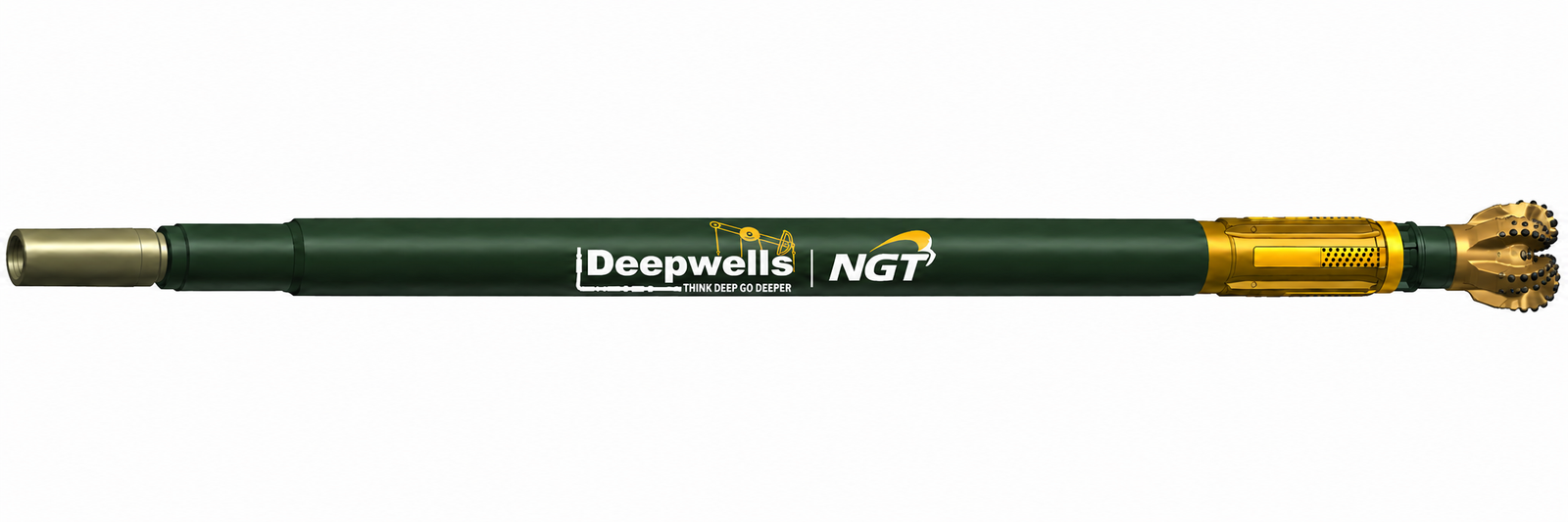
AVDS is a downhole tool for vertical drilling designed to achieve and maintain a vertical wellbore trajectory. This unique design allows operation in extreme high temperatures, when drilling in salt, steeply dipping beds or fault zones. When drilling in those conditions, it is often necessary to reduce weight on bit to prevent deviation problems that lead to the need for costly, time-consuming corrective runs. When using AVDS, it is possible to increase WOB without deviating the well trajectory. This usually results in increased ROP and, as a result, significant cost-efficiency. AVDS can be used both with a downhole motor and without it.
AVDS Technical Data Sheet
Questions & Answers
How is the tool activated?
Answer :The mechanism is automatic; there is no need to activate it. As soon as the borehole begins to deviate from the vertical, the tool’s “Automatic Control System” instantly reacts mechanically and opens hydraulic channels under one or two blades. The opposing blades extend, creating a corrective lateral force on the borehole wall and directing the borehole trajectory back to a strictly vertical path.
Do we have to use an MWD tool with this tool?
Answer: During the initial testing phase, this is mandatory to monitor the borehole’s verticality during testing and confirm the AVDS’s functionality without the risk of the drilled borehole not being vertical after drilling.
What are the recommended BHA design requirements, including stabilizer placement and spacing?
Answer:The next element to be installed above the vertical well drilling tool in the bottom hole assembly (BHA) is a stabilizer. It is also recommended to include additional stabilizers in the BHA: one at the first stand (drill collar) and a second at intervals of 100-120 meters. The diameter of the stabilizers above the vertical well drilling tool should be arranged from largest to smallest.
Do we need special software to install the tool?
Answer: No, the system works automatically, that’s the whole point.
Do you have any history data regarding the runs?
Answer:
Case histories :
- At the Yuzhny Alibek field (Caspineft) in Kazakhstan, test activities were carried out using AVDS-311.1. Based on the results of the tests, positive results from the use of AVDS-311.1 were obtained: 12 runs with the Smith BitType S-519BPX 12 1/4” (5-blade PDC bit), and 5 runs with Smith BitType GF15BVC (tri-cone bit) were completed, zenith angle value when drilling using AVDS-311.1 did not exceed 1.85° even in nonpersistent saline deposits. High WOB in compact rock intervals, which could lead to the very curving of the well, an increase in the ROP by 3-4 times compared to the offset well was allowed, which was drilled with a rotor or a turbodrill, one AVDS-311.1 drilled the entire interval with a diameter of 311.1 mm. The total drilling and flushing time on one AVDS-311.1 was 341 hours.
- (July 2022), operation on the project of Gazprom Burenie OOO, Astrakhan Burenie Branch, namely, on well No. 325 of the Astrakhan oil and gas condensate field continues, where, in cooperation with NII TS Pilot OOO, the AVDS-393.NGT product has already successfully drilled the corresponding section in the interval 380-1746m, and now the section with AVDS-295.NGT is being drilled (bottom as of May, 7, 2022 is 2220m). Despite the complex geology, NGT AVDS show consistent results both in maintaining the verticality of he wellbore and in the average POP of the BHA in comparison with the alternative expensive RSS system raditionally used on this project.
Is the tool easy to service and maintain? What would be the average tool life/run life between maintenance cycles?
Answer: We recommend performing maintenance after one or two wells (planned 200-300 drilling hours) to check the condition of internal components. The actual service interval is currently undefined. The criteria for sending the tool for inspection will be specified in the operating instructions; please be patient. If no criteria are met after one well, the tool can be used for the next.) , We plan to dispatch a specialist to perform this work.
What maintenance and inspection procedures are required after each run?
Answer : The main thing is to ensure tight sealing to prevent drilling fluid from drying out after work to prevent the deviation blades from drying out.
What field engineer qualifications are needed to run the tool (is this a standard MWD engineer?
Answer: One who supervises the drilling process and deviations from the vertical.
Can you please send us the tool’s fishing diagram so we can check for any internal restrictions?
Answer: Please wait for the data sheet and instructions in English; they will contain a dimensional drawing with dimensions and threads.
We noticed that the 8 1/2″ tool size ID is 1.57″, while end users usually request a minimum of 2.81″.
Answer: Unfortunately, due to the internal design, it is impossible to increase the size to 2.81”.
What pressure drop across the bit is required for optimal tool performance?
Answer: From 30 to 50 atmospheres, the calculation will also be provided in the instructions.
What are the maximum operating temperature and pressure ratings of the tool?
Answer :The standard is 100 degrees Celsius; if higher temperatures are required, heat-resistant seals can be installed.
Can we use the tool in any type of formation?
Answer: We don’t see any limitations, but testing is required in any case.
What is the typical deviation correction capability (e.g., maximum inclination correction per 100 ft)?
Answer:We have a general tolerance that the device should not allow the formation to deviate more than 5 degrees. This means it will hold the blade in the 0-5 degree range.
Can the tool be used with all downhole motors?
Answer: Yes, it’s possible, but our experience has only been with a rotary blade.
What are the minimum and maximum flow rates required for proper blade activation?
Answer: There are no restrictions, the main requirement is to ensure the required pressure differential.
Contact Us